Many people do good work that almost no one sees, because they hate the idea of promoting themselves. Austin Kleon, a writer and artist, argues there is a better way: share your process openly and generously, and let the people who care about the same things find you.
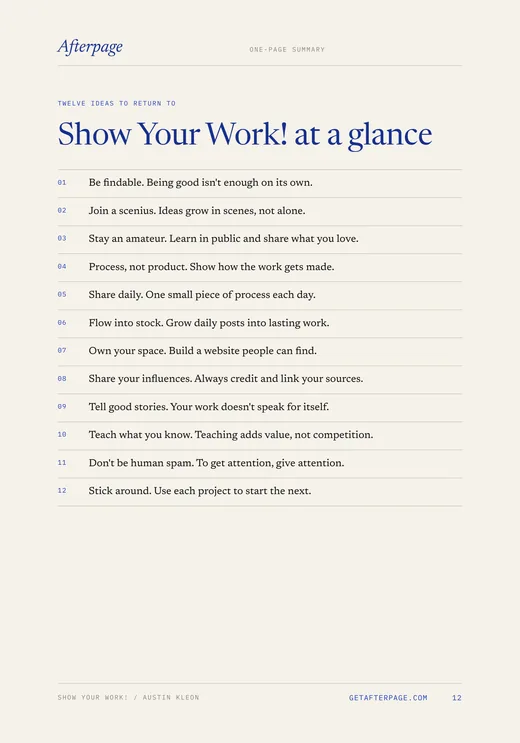
This guide condenses Show Your Work! into twelve ideas, from joining a creative scene and sharing a little every day to telling better stories, teaching what you know and sticking with your work through ups and downs. It closes with a one-page summary, two worksheets and a cheat sheet.
1 Be findable, and join a scene
Austin Kleon says the question readers ask him most is how to get noticed. He agrees with Steve Martin's advice to be so good they can't ignore you, but adds a catch: being good is not enough. To be found, you have to be findable. The people he admires most build sharing into their routines, posting bits of their work, ideas and learning as they go.
2 Stay an amateur, use your voice and remember you'll die
Kleon argues that amateurs often have an advantage. They work out of love, have little to lose and are willing to try things and share the results. They are not afraid to look silly, and because they learn in the open, others can learn from their mistakes. Sometimes a fellow learner can explain a problem better than an expert who solved it long ago.
3 Think process, not product
Kleon draws a line between artwork and art work: the finished piece and the daily process behind it. Artists were traditionally taught to keep their process private and only show finished products. That made sense when galleries and magazines were the only ways to reach an audience. Today, he says, anyone can share as much of their process as they like, almost for free.
4 Share something small every day
Overnight success, Kleon says, is usually about a decade of hard work. Building a body of work takes a lifetime, but you can focus on one day at a time. After each day's work, find one small piece of your process to share. Early on, share what inspires you. In the middle of a project, share methods or works in progress.
5 Turn flow into stock, and own your space
Kleon borrows writer Robin Sloan's idea of stock and flow. Flow is the stream of daily posts and updates that remind people you exist. Stock is the durable work that is as interesting in two years as it is today. The trick is to keep up your flow while building stock in the background.
6 Open up your cabinet of curiosities
Wealthy Europeans in the sixteenth and seventeenth centuries often kept cabinets of curiosities, rooms full of rare objects that displayed their interests. Kleon says we all have our own collections, physical or mental, and they shape our taste and our work. Collecting and creating are closer than they seem.
7 Tell good stories about your work
Kleon describes an experiment from the book Significant Objects. The authors bought cheap items from thrift stores and yard sales, paid writers to invent stories about them and listed them on eBay with the stories as descriptions. Trinkets bought for $128.74 sold for $3,612.51. Stories, he argues, change how people value things.
8 Teach what you know
Kleon describes visiting Franklin Barbecue in Austin, Texas, where pitmaster Aaron Franklin was filming a series showing every step of how he smokes meat. Barbecue is a secretive, competitive world, yet Franklin shared everything. The restaurant still had a line around the block and sold out daily.
9 Don't be human spam
Kleon describes people who want attention but give none: the writer who doesn't read, the musician who pushes flyers but never goes to shows. He calls them human spam. If you want fans, he says, you have to be a fan first, and if you want to be part of a community, be a good citizen of it.
10 Learn to take a punch
The more people see your work, the more criticism you will get. Kleon offers ways to take it. Relax and breathe, since fear is often imagination taking a wrong turn. Strengthen your neck by putting out lots of work and letting people react, until criticism stops feeling fatal.
11 Don't be afraid to sell your work
People need to eat and pay rent, Kleon says, so drop the romantic idea that money corrupts art. Michelangelo painted the Sistine Chapel ceiling on commission. Mario Puzo wrote The Godfather partly to pay off debts. Don't sneer at artists who succeed, and celebrate when people you like do well.
12 Stick around
Careers have ups and downs, and Kleon says the people who get what they want are often the ones who stay long enough. Don't quit too early. Success and failure are no guarantee of what comes next, so after every project you face the same question: what's next?
Show Your Work! in short
Show Your Work! is a short guide to sharing your creativity without feeling like you are promoting yourself. Austin Kleon argues that being good is not enough: you also have to be findable. That means joining a scene, learning in the open like an amateur and sharing your process, not just finished products.
Get the free 15-page PDF guide ↑