Most career advice says the same thing: find your passion and follow it. Cal Newport, a computer science professor, wanted to know whether that advice actually works. He interviewed people who love their work, from farmers and writers to programmers and scientists, and studied the research on job satisfaction.
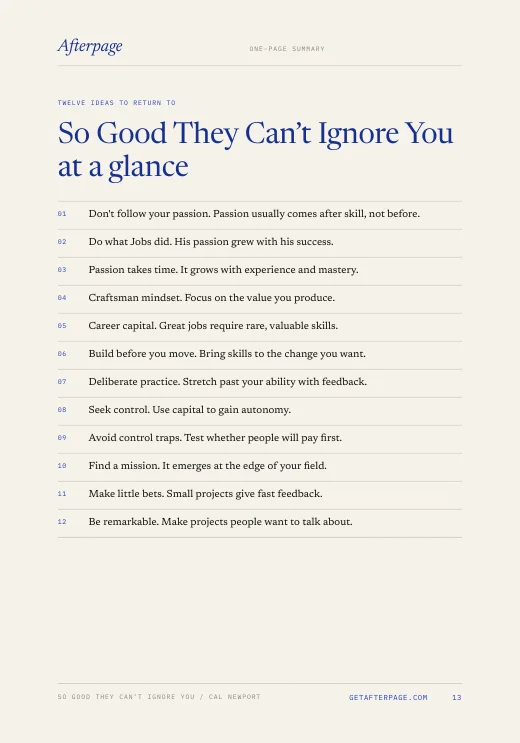
What he found led him to four rules that turn the usual advice upside down. This guide condenses So Good They Can’t Ignore You into twelve ideas, with the stories and studies behind them and practical steps for each. It closes with a one-page summary, two worksheets and a cheat sheet.
1 Follow your passion is risky advice
Cal Newport opens with Thomas, who studied philosophy and religion and decided Zen practice was the key to a meaningful life. He became a lay monk at a monastery in the Catskill Mountains, living his dream job. About a year in, walking through the woods, he realized he was no happier, and began to cry.
2 What Steve Jobs did, not what he said
In 2005, Steve Jobs told Stanford's graduating class that the only way to do great work is to love what you do, and that if you have not found it yet, you should keep looking. The speech became one of the best-known pieces of career advice of its time.
3 Passion is rare, slow and a side effect of mastery
Newport cites three lines of research. In a 2002 study, psychologist Robert Vallerand surveyed 539 Canadian university students. Most had passions, but the top five were dance, hockey, skiing, reading and swimming. Less than 4 percent of all the passions named had anything to do with work or education.
4 Adopt the craftsman mindset
Rule two is to be so good they can't ignore you, a phrase from the comedian Steve Martin. Asked in an interview for advice to aspiring performers, Martin said people wanted tips on agents and scripts, but his answer was always to be so good they can't ignore you. If you get really good, he said, people will come to you.
5 Build career capital
Newport argues that the traits that make a job great, such as creativity, impact and control, are rare and valuable. So, by basic economics, you need something rare and valuable to offer in return. He calls those rare and valuable skills career capital, and says building them is the foundation of work you love.
6 Career capital in action
Newport profiles two people who built careers they love by building capital first. Alex Berger became a television writer in his early thirties. In college he had been the top-ranked debater in the country, and he took the same approach to writing: get specific feedback, keep improving and seek out harder challenges.
7 Use deliberate practice to get better
Newport's main strategy for building career capital is deliberate practice. The term comes from psychologist Anders Ericsson, who defined it as activity designed, usually by a teacher, solely to improve specific parts of a person's performance. Research has found it key to excellence in fields from chess and medicine to music and sports.
8 Control is a powerful trait in work you love
Rule three is turn down a promotion, and it is about control. Newport argues that having a say in what you do and how you do it is one of the most powerful traits for creating work you love. Research and his interviews point the same way: people with more control tend to be happier and more engaged.
9 Avoid the two control traps
Newport describes two traps. The first is seeking control before you have career capital. He tells of Jane, a talented student who left college to pursue a vision of an adventurous life funded by passive income online. She had plenty of autonomy, but no valuable skills to support it, and ended up broke.
10 A mission gives work meaning
Rule four is think small, act big, and it is about mission. Newport profiles Pardis Sabeti, a Harvard professor of evolutionary biology who clearly enjoys her life. She plays guitar in a band and seems unusually relaxed for someone in a demanding field. He traces her satisfaction to a clear mission.
11 Missions need little bets
Even with a mission, Newport argues, you should not make one big bet. He profiles archaeologist Kirk French, whose mission was to bring modern archaeology to a mass audience. French tried several small projects, such as reviving an old documentary and building a film series for students.
12 Make your mission remarkable
Newport's final principle is the law of remarkability. A project tied to a mission, he argues, succeeds when it makes people want to talk about it, and when it is launched in a place where that talk can spread easily.
So Good They Can’t Ignore You in short
So Good They Can’t Ignore You challenges the advice to follow your passion. Cal Newport argues that most people do not have a preexisting passion that fits a career, that passion for work grows over time and that it is usually a side effect of becoming very good at something.
Get the free 16-page PDF guide ↑