Many businesses struggle not because their work is bad, but because their offer looks just like everyone else's. Alex Hormozi, an entrepreneur who built and sold businesses in fitness and other fields, argues that the offer, meaning what you provide, how you charge and on what terms, is the most powerful lever most owners have.
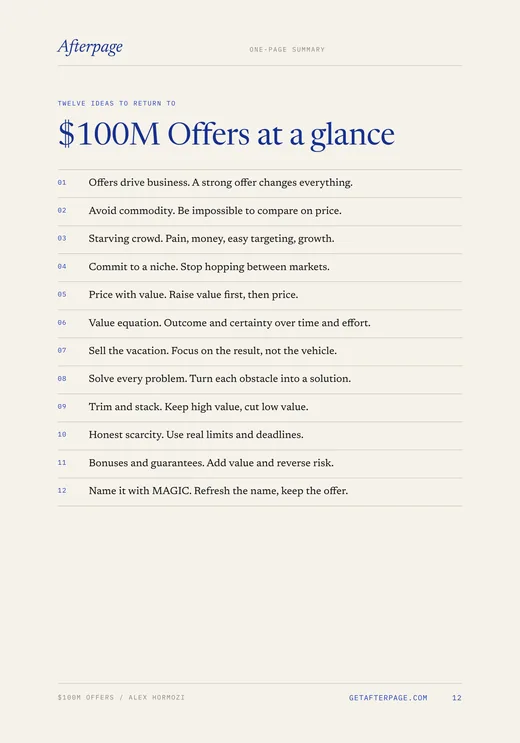
This guide condenses $100M Offers into twelve ideas, from picking the right market and pricing for value to building, enhancing and naming an offer. It closes with a one-page summary, two worksheets and a cheat sheet.
1 An offer saved the business
Alex Hormozi opens at his lowest point, on Christmas Eve 2016. He had sold five of his six gyms to fund a new company, Gym Launch, which would travel to gyms and fill them with members using an offer he had refined. Then a partner withdrew almost all of the money from their account, and a payment processor said it would hold $120,000 of his sales for six months.
2 Escape the commodity trap
Hormozi defines an offer as what you will provide, how you get paid and the terms of the deal. It is the first thing a new customer meets, so it drives the whole business. A bad offer means losses, a decent one means stagnation and what he calls a Grand Slam Offer can transform a business.
3 Find a starving crowd
Hormozi tells of a marketing professor who asked students what single advantage they would want for a hot dog stand. Students suggested location, quality and price. The professor's answer was a starving crowd. Strong demand can rescue a mediocre offer.
4 Pick a niche and commit
The three markets that will always exist, Hormozi argues, are health, wealth and relationships, because lacking any of them causes deep pain. The goal is to find a smaller group within one of those markets that has strong pain, money, easy targeting and growth.
5 Charge enough to deliver great results
Hormozi says lowering your price is the easiest way to make an offer more attractive, and usually the wrong one. You can only cut to zero, but you can raise prices much higher. Most owners copy competitors and price slightly below them, he notes, even though those competitors are often barely profitable.
6 Use the value equation
At the core of the book is Hormozi's value equation. Value rises with two factors: the dream outcome a customer wants and their perceived likelihood of achieving it. Value falls with two others: the time it takes to get the result and the effort and sacrifice required.
7 Turn problems into solutions
Hormozi's first gym struggled to sell a $99 monthly boot camp when a big gym chain charged $29. So he asked what people really wanted. Nobody wanted a membership, he realized. They wanted to lose weight. He shifted to selling a goal: lose 20 pounds in six weeks. He calls this selling the vacation, not the plane flight.
8 Choose delivery, then trim and stack
Next, Hormozi brainstorms ways to deliver each solution. Options include one-on-one, small-group or one-to-many formats; doing it for customers, with them or teaching them to do it themselves; and live or recorded delivery. He also suggests a test: what would you provide if customers paid ten times your price, or how would you still help them at a tenth of it?
9 Use scarcity and urgency honestly
Hormozi argues that fear of missing out pushes people to act. Scarcity limits how many people can buy, for example limited spots, limited bonuses or a product that will never be offered again. Urgency limits when people can buy, through a real deadline.
10 Stack bonuses to increase value
Hormozi credits marketer Jason Fladlien with his appreciation for bonuses. A single offer, he argues, seems less valuable than the same offer split into parts and presented one by one. That is why the old TV commercials kept saying there was more: each addition widened the gap between price and value.
11 Reverse the risk with a guarantee
The biggest objection to any purchase, Hormozi says, is risk: the fear that it will not work. A guarantee shifts that risk from the buyer to you. A strong guarantee states the result, the time period and what you will do if it is not achieved.
12 Name it well, and refresh it
A great offer only works if people notice it. Hormozi notes that a free six-week stress-release challenge will usually draw more interest than a float tank session, even if it is the same service. Offers also tire over time, especially in local markets, so he suggests renaming them to refresh interest while keeping the substance the same.
$100M Offers in short
$100M Offers is a practical guide to building what Alex Hormozi calls a Grand Slam Offer, one so valuable that buyers stop comparing it on price. He argues that the right market matters most: look for pain, purchasing power, easy targeting and growth, then commit to a niche. He urges owners to raise value first, then charge enough to deliver excellent results.
Get the free 15-page PDF guide ↑