Afterpage

Free Key Ideas guide · 16-page PDF

The War of Art Key IdeasFree PDF guide + 7-day plan

Book by Steven Pressfield

The book’s 12 main ideas, a one-page summary, two worksheets and a cheat sheet arrive in your inbox now, and a 7-day plan by email starts tomorrow: the big ideas on day 1, then one small action a day.

Your book The War of Art Steven Pressfield

Free. 7 days of actions, then up to 3 membership emails. One click to stop. Privacy.

Buy this book at Bookshop.org

We earn a small commission if you buy through Bookshop.org, which supports independent bookstores.

Cover of the Afterpage Key Ideas guide to The War of Art by Steven Pressfield.

Summary · 4-minute read

The War of Art summary

Drawn from our Key Ideas guide to The War of Art by Steven Pressfield. The free PDF goes further, with a one-page summary, worksheets and a cheat sheet.

Almost everyone has a project they keep putting off: a book, a business, a fitness plan or a change they know they should make. Steven Pressfield, a novelist and screenwriter who spent many years struggling before his first novel was published, gives the force that stops us a name, Resistance, and describes how to beat it.

This guide condenses The War of Art into twelve ideas, from how Resistance works and how to spot its symptoms, to what it means to turn pro and why work done for its own sake lasts. It closes with a one-page summary, two worksheets and a cheat sheet.

1 The hard part is sitting down to work

Steven Pressfield opens with his own workday. He showers, eats, makes calls, puts on his lucky boots and sweatshirt, says a short prayer and sits down to write at about ten-thirty. When he starts making typos, about four hours later, he stops. He does not judge the pages. What matters is that he showed up and gave it everything.

2 Know when Resistance will appear

Pressfield lists the activities that most often trigger Resistance. They include any creative calling, starting a business or nonprofit, any diet or health program, spiritual practice, education, breaking a bad habit, acts of moral courage, helping others, and commitments of the heart such as marriage or having a child.

3 Resistance is internal, impersonal and relentless

Pressfield describes the nature of Resistance. It is invisible but can be felt. It seems to come from outside, from jobs, spouses or children, but it really comes from within. It will lie, bargain or bully, and it will say anything to keep you from your work.

4 Spot the symptoms

Procrastination, Pressfield says, is the most common form of Resistance because it is the easiest to rationalize. We do not say we will never write the symphony. We say we will start tomorrow. Over time, delay becomes a habit, and we put off our lives until our deathbeds. But at any moment, he insists, we can sit down and do the work.

5 Fear and doubt can point the way

One of Pressfield's most useful ideas is that Resistance can serve as a compass. The more important a calling or action is to our growth, the more Resistance we will feel toward it. So the projects we fear most are often the ones we most need to do.

6 Turn pro

Book Two is about defeating Resistance, and Pressfield's answer is to turn pro. By professional, he does not mean doctors and lawyers. He means a mindset. The amateur plays for fun, part-time, as a weekend warrior. The professional is committed full-time, every day.

7 Show up whether or not you feel inspired

Pressfield tells a story about the novelist Somerset Maugham, who was asked if he wrote on a schedule or only when inspired. He replied that he wrote only when inspiration struck, and fortunately it struck every morning at nine o'clock sharp.

8 Act in spite of fear and accept no excuses

The amateur believes fear must be conquered before the work begins. The professional knows fear never fully goes away. Pressfield returns to Henry Fonda: after being sick in his dressing room, Fonda would clean up and walk onstage anyway, knowing the fear would fade once he was performing.

9 Don't take failure or success personally

A thick skin, Pressfield says, does not mean feeling nothing. It means placing your professional identity somewhere other than your ego. Fear of rejection runs deep, he argues, because humans evolved to fear being cast out of the tribe. He knew a writer who finished a fine novel but could not bring himself to send it out.

10 Commit, and help will come

Book Three moves into what Pressfield calls the higher realm. He believes that when we sit down to work day after day, unseen forces come to our aid. Ideas arrive. Insights build. He calls these forces the Muse or angels, and admits that others might call them the unconscious.

11 Work territorially, not hierarchically

Pressfield says people define themselves in one of two ways. In a hierarchy, like a pecking order, we judge ourselves by our rank and by what others think of us. In a territory, like an animal's home ground, we find our security in a place or activity that sustains us.

12 Do the work for its own sake

Pressfield closes with the Bhagavad Gita's teaching that we have a right to our labor, but not to its results. We should do our work for its own sake, not for fame, money or applause. He goes further, suggesting the work can be offered up as a kind of devotion.

The War of Art in short

The War of Art names the force that keeps us from our most important work: Resistance. Steven Pressfield argues that it appears whenever we choose long-term growth over comfort, in art, business, health or relationships. It is internal and impersonal, never sleeps and is strongest near the finish line. It shows up as procrastination, drama, distraction and criticism of others.

Get the free 16-page PDF guide

Key ideas & lessons

The War of Art key ideas: 12 lessons

For writers, artists, founders and anyone who keeps putting off the work that matters most to them. Less useful if you want a detailed productivity system.

Get the free PDF

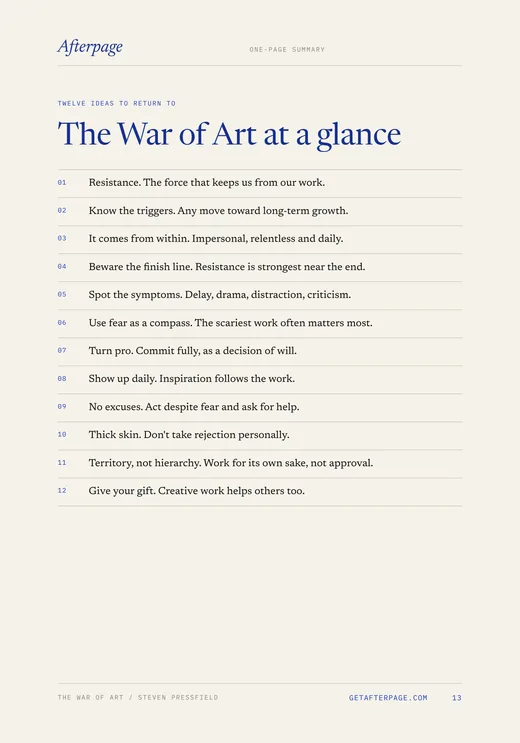
Page 13 of the guide: The War of Art at a glance, the 12 ideas on one page.
Page 13: the one-page summary
  1. Resistance. The force that keeps us from our work.
  2. Know the triggers. Any move toward long-term growth.
  3. It comes from within. Impersonal, relentless and daily.
  4. Beware the finish line. Resistance is strongest near the end.
  5. Spot the symptoms. Delay, drama, distraction, criticism.
  6. Use fear as a compass. The scariest work often matters most.
  7. Turn pro. Commit fully, as a decision of will.
  8. Show up daily. Inspiration follows the work.
  9. No excuses. Act despite fear and ask for help.
  10. Thick skin. Don't take rejection personally.
  11. Territory, not hierarchy. Work for its own sake, not approval.
  12. Give your gift. Creative work helps others too.

The first lesson to tryChoose your one most important project. Set a fixed daily start time and session length for this week, show up every day regardless of mood and record each session completed.

Day 1

The ideas the week uses

Steven Pressfield, a novelist who struggled for years before publishing, names the force that stops us doing our important work: Resistance. His answer is to stop waiting for inspiration and work like a professional.

  1. Resistance is the enemy. Pressfield describes Resistance as an inner force that shows up whenever we try something that would help us grow, from creative work to a health plan.
  2. Procrastination is its favorite tool. We rarely say never. We say tomorrow, and delay becomes a habit.
  3. Fear points the way. The more important a project is to us, Pressfield argues, the more Resistance we feel toward it.
  4. Turn pro. Professionals show up every day, whether or not they feel inspired, and keep working through fear.
  5. Work for its own sake. Pressfield closes with the idea that we have a right to our work, but not to its results.

Where it overreachesThe last part of the book is openly spiritual, describing the Muse and unseen help. You can use the practical advice without sharing those beliefs. Some of his views on mental health and therapy are personal opinions, not advice.

Days 2 to 7

How to apply The War of Art

10 to 20 minutes each, with a two-minute version for a bad day.

Printable week card (one page)

  1. 2Name your projectWrite down the one project you keep putting off that matters most to you.
  2. 3Spot your ResistanceWatch for Resistance today and write down each time it shows up.
  3. 4Sit down at a set timeChoose a start time and work on your project for 30 minutes, whatever you feel.
  4. 5Work through the fearDo the part of your project you've been most afraid of, for at least 15 minutes.
  5. 6Separate your work from your egoWrite down how you'd measure a good day on this project without praise, sales or likes.
  6. 7Commit to a daily sessionPut a daily work session for your project in your calendar for the next month.

Sample

Day 3, in full

This is what lands in your inbox that day.

AfterpageDay 3 of 7 · Action

Spot your Resistance

Today’s action · 10 to 20 minutes

Watch for Resistance today and write down each time it shows up.

How

Keep a note open. Each time you delay, distract yourself or invent a reason not to work, write the time and the form it took. Count them at the end of the day.

Why this one

Pressfield lists the many symptoms of Resistance, and seeing them is the first step to beating them.

If today is a bad day

Write down the last thing you did instead of your project.

In short

Questions about this book

What are the key ideas of The War of Art?

The Afterpage Key Ideas guide condenses The War of Art by Steven Pressfield into 12 ideas: Resistance; Know the triggers; It comes from within; Beware the finish line; Spot the symptoms; Use fear as a compass; Turn pro; Show up daily; No excuses; Thick skin; Territory, not hierarchy; Give your gift.

Is there a free The War of Art summary?

Yes. This page has a 4-minute The War of Art summary drawn from the Afterpage Key Ideas guide. The full guide is a free 16-page PDF with the 12 key ideas, a one-page summary, two worksheets and a cheat sheet, sent by email.

Is The War of Art Key Ideas guide free?

Yes. Enter your email and the 16-page PDF guide arrives in a minute. Next, a 7-day plan by email, starting tomorrow: the big ideas on day 1, then one small action a day. It is free for your first book; membership covers every book.

What is The War of Art about?

The War of Art names the force that keeps us from our most important work: Resistance. Steven Pressfield argues that it appears whenever we choose long-term growth over comfort, in art, business, health or relationships. It is internal and impersonal, never sleeps and is strongest near the finish line. It shows up as procrastination, drama, distraction and criticism of others.

What are the main lessons of The War of Art?

Resistance. Know the triggers. It comes from within. Beware the finish line. Spot the symptoms. Use fear as a compass. Turn pro. Show up daily. No excuses. Thick skin. Territory, not hierarchy. Give your gift. The first one to try: Choose your one most important project. Set a fixed daily start time and session length for this week, show up every day regardless of mood and record each session completed.

Who is The War of Art by Steven Pressfield for?

For writers, artists, founders and anyone who keeps putting off the work that matters most to them. Less useful if you want a detailed productivity system.

What are the main ideas in The War of Art?

Steven Pressfield, a novelist who struggled for years before publishing, names the force that stops us doing our important work: Resistance. His answer is to stop waiting for inspiration and work like a professional. Resistance is the enemy; Procrastination is its favorite tool; Fear points the way; Turn pro; Work for its own sake.

What do you do in the Afterpage week for The War of Art?

You get the Key Ideas guide first. The next day, day 1 is a short summary. Then one action a day, each 10 to 20 minutes: Name your project; Spot your Resistance; Sit down at a set time; Work through the fear; Separate your work from your ego; Commit to a daily session. Day 7 also has a recap.

Where does The War of Art overreach?

The last part of the book is openly spiritual, describing the Muse and unseen help. You can use the practical advice without sharing those beliefs. Some of his views on mental health and therapy are personal opinions, not advice.

What is the first action in The War of Art week?

Name your project. Write down the one project you keep putting off that matters most to you. If you only have two minutes: Write the name of the project you've put off longest.

Membership

Your first book is free. Members get every book.

Pick any book on the shelf, as often as you like, and its Key Ideas guide arrives right away. Next, a 7-day plan by email, starting tomorrow. New books are added regularly.

  • Monthly

    $9.99/month

    Cancel anytime.

  • Yearly

    $79/year

    Save about a third against the standard $9.99 monthly rate.

Want every book? Founding members pay $4.99/month. See membership

Keep reading

Books like The War of Art

Best books on productivity →