Free Key Ideas guide · 16-page PDF
Building a Second Brain summary and Key Ideas
This free plan: turn your saved notes into one piece of work you can share.
Book by Tiago Forte
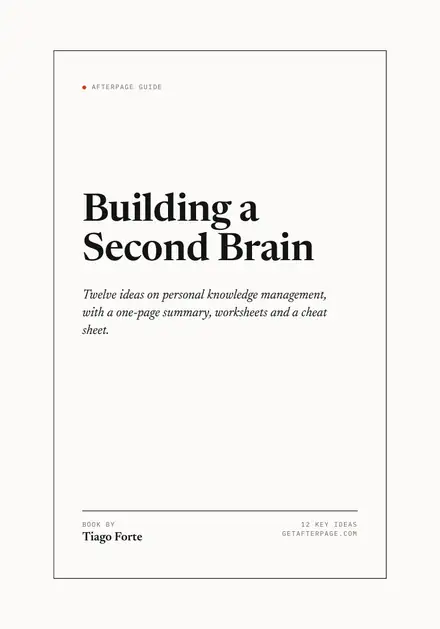
- Free 16-page PDF12 Key Ideas, a one-page summary, two worksheets and a cheat sheet.
- A 7-day plan by emailStarts tomorrow: one small action a day.
- No card neededNew to the book? Start with the Key Ideas. Read it already? The week puts it to use.
We earn a small commission if you buy through Bookshop.org, which supports independent bookstores.
Summary
Building a Second Brain summary: the 12 Key Ideas
You read articles, save links and take notes, yet when you need an idea, you cannot find it. Tiago Forte's Building a Second Brain offers a system for keeping and using what you learn.
This guide condenses the book into twelve ideas, a one-page summary, two worksheets and a cheat sheet. The system is the author's own method, so the guide describes it as his approach.
1 A second brain is a trusted place outside your head
Tiago Forte describes Building a Second Brain as a system drawing on personal knowledge management, or PKM. The aim is to harness what you know in the way that personal computers, personal finance and personal productivity changed other areas of life. At its core is the habit of saving ideas in a place you control.
2 Make ideas concrete to think clearly
Forte names four capabilities of a second brain. The first is to make our ideas concrete. Before we can do anything with ideas, he says, we must off-load them from our minds into concrete form, and only then can we think clearly and work with them.
3 Let ideas incubate and sharpen your perspective
The third capability is to incubate ideas over time. Forte says people often take on tasks by drawing only on ideas that come to mind in the moment. He calls this the heavy lift, demanding instant results from the brain with no support system.
4 The CODE method: capture, organize, distill, express
Forte's method has four steps, abbreviated CODE. Capture means keeping what resonates. Organize means saving for actionability. Distill means finding the essence. Express means showing your work. He previews each in an early chapter and then covers them in depth.
5 Capture only what resonates
Forte says we cannot consume every bit of information streaming from our devices. We will be exhausted if we try. He urges you to adopt the perspective of a curator who makes intentional decisions about what to let in, like a scientist capturing only the rarest butterflies.
6 Four criteria for what to keep
To avoid keeping too much or too little, Forte suggests four questions. Does it inspire me? Is it useful? Is it personal? Is it surprising? An inspiring item can be a quote, photo or story, such as his folder of customer testimonials that he opens when he doubts his work.
7 PARA: organize by projects, areas, resources and archives
Forte advises organizing notes for action. His system, PARA, has four categories. Projects are short-term outcomes you are working on now, with a beginning, an end and a clear outcome. Areas are ongoing responsibilities, such as finances, health or a job duty, with no final objective.
8 Where do I put this? Use a simple checklist
Forte says the question that frightens every organizer is where to put a note. He recommends separating capture from organizing. Keeping what resonates in the moment is a separate decision from deciding where something belongs for the long term.
9 Progressive summarization: distill in layers
Forte's technique for distilling notes is Progressive Summarization. You highlight the main points of a note, then the main points of those highlights, and so on, using different formatting for each layer. This makes the note quickly scannable in future.
10 Express early with intermediate packets
Forte says the final stage, Express, is about refusing to wait until everything is ready before sharing. Share earlier, more often and in smaller chunks to test what works and gather feedback, which flows back into the second brain as the start of the next iteration.
11 Bridge the gap: archipelago, Hemingway bridge and smaller scope
For bringing creative work together, Forte offers three strategies. The Archipelago of Ideas gathers sources and points as stepping-stones, replacing the blank page with a document of quotes and notes, which you then link into an order that makes sense.
12 Keep the system alive with weekly and monthly reviews
Forte shares his weekly review checklist, completed every three to seven days. Clear the email inbox, check the calendar, clear the computer desktop, clear the notes inbox and choose tasks for the week. Action items go to the task manager and notes to the notes app.
Building a Second Brain in short
Forte's method is to keep ideas in a trusted place outside your head, using four steps: capture what resonates, organize for action with PARA, distill with progressive summarization and express your work in small packets.
In short
Questions about this book
What is Building a Second Brain about?
Forte's method is to keep ideas in a trusted place outside your head, using four steps: capture what resonates, organize for action with PARA, distill with progressive summarization and express your work in small packets.
Who is Building a Second Brain by Tiago Forte for?
For knowledge workers, writers, and students who save a lot of notes and links but rarely use them. Less useful if you don't take notes at all or prefer paper only.
What are the Key Ideas of Building a Second Brain?
The Afterpage Key Ideas guide condenses Building a Second Brain by Tiago Forte into 12 ideas: Second brain, Concrete, Incubate, CODE, Capture, Criteria, PARA, Filing, Summarize, Packets, Bridges and Reviews. It also has a one-page summary, two worksheets and a cheat sheet.
Is the Building a Second Brain Key Ideas guide free?
Yes. Every guide and 7-day plan is free. Enter your email and the 16-page PDF guide arrives in a minute. Next, a 7-day plan by email, starting tomorrow: one small action a day from the book.
What do you do in the Afterpage week for Building a Second Brain?
You get the Key Ideas guide first. Day 1 arrives the next day with one small action from the book. Days 2 to 7 are one action a day, with a two-minute version for a busy day. Day 7 also has a recap.
Do I need to have read Building a Second Brain?
No. Start with the Key Ideas guide, then the week: one small action a day. If you have read it, the week puts it to use.
- Deep Work summaryCal Newport · free Key Ideas guide
- Digital Minimalism summaryCal Newport · free Key Ideas guide
- Essentialism summaryGreg McKeown · free Key Ideas guide
- Four Thousand Weeks summaryOliver Burkeman · free Key Ideas guide
- Getting Things Done summaryDavid Allen · free Key Ideas guide
- Indistractable summaryNir Eyal · free Key Ideas guide