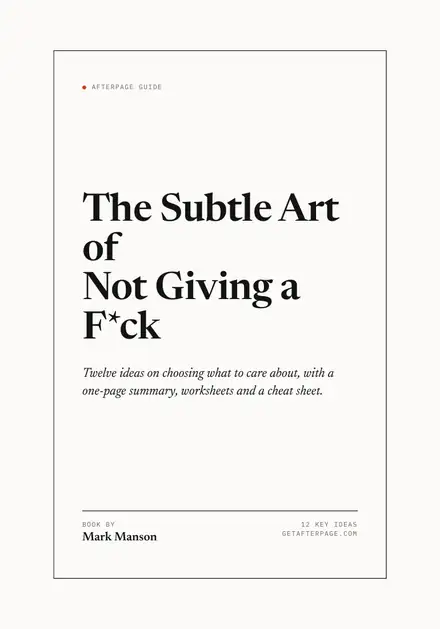
Free Key Ideas guide · 16-page PDF
The Subtle Art of Not Giving a F*ck summary and Key Ideas
This free plan: decide which struggle is worth it for you.
Book by Mark Manson
- Free 16-page PDF12 Key Ideas, a one-page summary, two worksheets and a cheat sheet.
- A 7-day plan by emailStarts tomorrow: one small action a day.
- No card neededNew to the book? Start with the Key Ideas. Read it already? The week puts it to use.
We earn a small commission if you buy through Bookshop.org, which supports independent bookstores.
Summary
The Subtle Art of Not Giving a F*ck summary: the 12 Key Ideas
You are told to be happier, fitter, richer and more confident, and the effort of trying leaves you feeling like you are falling short. Many people spend years chasing a better version of themselves without feeling better.
Mark Manson argues that the answer is to care about fewer things and choose them carefully. This guide condenses his book into twelve ideas, with a one-page summary, two worksheets and a cheat sheet. The book's language is blunt, and the guide keeps its ideas but drops the profanity.
1 Success can come from being honest about your flaws
Mark Manson begins with Charles Bukowski, a man you would not expect in a self-help book. Bukowski wanted to be a writer, but for decades magazines and publishers rejected his work as crude. He worked as a post office letter-filer, spent his pay on drink and gambling, and was around fifty when a small publisher took a chance on him.
2 Anxiety about anxiety: the feedback loop
Manson describes a quirk of the mind that he calls the feedback loop from hell. You get anxious about confronting someone, then you wonder why you are anxious, and now you are anxious about being anxious.
3 The backwards law: caring less can help
Manson says people often imagine not caring as serene indifference, a calm that nothing can shake. He points out that someone who feels nothing is, in his phrasing, a psychopath, which nobody should want to imitate.
4 Happiness comes from solving problems you enjoy having
Manson argues that problems are a constant. Solving your health problem by joining a gym creates new ones, such as getting up early and showering for work. Fixing a lack of couple time with a weekly date night creates the problem of finding things both of you enjoy and paying for dinner. Problems never stop, he says. They merely get exchanged or upgraded.
5 Choose your struggle
Manson says that asking people what they want from life gets a generic answer: to be happy, with a good family and a job they like. Everyone wants what feels good, so the answer says little.
6 You are probably not exceptional, and that is fine
Manson says most of us are average at most things. Even someone exceptional at one thing is probably average or below average at most others. To be truly great you must devote enormous time and energy, and since both are limited, few people become exceptional at more than one thing, if any.
7 Your values set the scoreboard you measure yourself by
Manson tells of Dave Mustaine, a guitarist kicked out of a band in 1983 just before it recorded its first album. He formed Megadeth, which sold over 25 million albums, fueled by anger and a wish to outdo his former band. By ordinary standards, Mustaine is wildly successful. But by his own metric, being more popular than Metallica, Manson says he is a failure.
8 Good values are reality-based, constructive and controllable
Manson lists poor values. Pleasure, he says, is a bad thing to organize your life around. It is the most superficial form of life satisfaction, and in his account it is an effect of happiness, not a cause. He says research shows that people who focus on superficial pleasures end up more anxious and depressed.
9 Responsibility is not the same as fault
Manson says that with great responsibility comes great power, and that this reverses the familiar saying. The more responsibility you accept in your life, the more power you exercise over it. Accepting responsibility for your problems is the first step in solving them.
10 Your mind invents meaning, so hold beliefs loosely
Manson describes an experiment. A person sits in a room with buttons and is told that doing the right thing makes a light flash and win a point. Within ten to fifteen minutes, each person has worked out a sequence, such as standing on one foot or tapping the ceiling, but the points were random.
11 Failure and action come before motivation
Manson tells a story about Picasso, who drew on a napkin in a Spanish cafe and, asked to sell it, named a price of $20,000. When the woman objected that it took two minutes, Picasso said it took him over sixty years to draw it. Improvement, Manson says, rests on thousands of small failures.
12 Commit, say no, and keep death in view
Manson argues that more is not always better. Faced with too many options, he says, we suffer the paradox of choice. Choosing among twenty-eight places to live leaves you doubting yourself for years, while choosing among two leaves you more satisfied. Committing to one person, place or activity gives access to rewards of depth that breadth cannot.
The Subtle Art of Not Giving a F*ck in short
Manson's central claim is that a good life comes from caring about fewer, better things and accepting the pain that comes with them. Happiness is not a state you reach but the result of solving problems you want to solve.
In short
Questions about this book
What is The Subtle Art of Not Giving a F*ck about?
Manson's central claim is that a good life comes from caring about fewer, better things and accepting the pain that comes with them. Happiness is not a state you reach but the result of solving problems you want to solve.
Who is The Subtle Art of Not Giving a F*ck by Mark Manson for?
For people tired of positive-thinking advice who want a blunt take on values, responsibility, and what's worth caring about. The tone is profane and sarcastic, which some readers love and others don't.
What are the Key Ideas of The Subtle Art of Not Giving a F*ck?
The Afterpage Key Ideas guide condenses The Subtle Art of Not Giving a F*ck by Mark Manson into 12 ideas: Honesty, Loop, Backwards law, Problems, Struggle, Average, Metrics, Good values, Responsibility, Certainty, Action and Commit. It also has a one-page summary, two worksheets and a cheat sheet.
Is The Subtle Art of Not Giving a F*ck Key Ideas guide free?
Yes. Every guide and 7-day plan is free. Enter your email and the 16-page PDF guide arrives in a minute. Next, a 7-day plan by email, starting tomorrow: one small action a day from the book.
What do you do in the Afterpage week for The Subtle Art of Not Giving a F*ck?
You get the Key Ideas guide first. Day 1 arrives the next day with one small action from the book. Days 2 to 7 are one action a day, with a two-minute version for a busy day. Day 7 also has a recap.
Do I need to have read The Subtle Art of Not Giving a F*ck?
No. Start with the Key Ideas guide, then the week: one small action a day. If you have read it, the week puts it to use.
Keep reading
Books like The Subtle Art of Not Giving a F*ck
- Can’t Hurt Me summaryDavid Goggins · free Key Ideas guide
- Ikigai summaryHéctor García and Francesc Miralles · free Key Ideas guide
- The 7 Habits of Highly Effective People summaryStephen R. Covey · free Key Ideas guide
- The Let Them Theory summaryMel Robbins · free Key Ideas guide
- The Obstacle Is the Way summaryRyan Holiday · free Key Ideas guide