Afterpage

Free Key Ideas guide · 15-page PDF

The Obstacle Is the Way Key IdeasFree PDF guide + 7-day plan

Book by Ryan Holiday

The book’s 12 main ideas, a one-page summary, two worksheets and a cheat sheet arrive in your inbox now, and a 7-day plan by email starts tomorrow: the big ideas on day 1, then one small action a day.

Your book The Obstacle Is the Way Ryan Holiday

Free. 7 days of actions, then up to 3 membership emails. One click to stop. Privacy.

Buy this book at Bookshop.org

We earn a small commission if you buy through Bookshop.org, which supports independent bookstores.

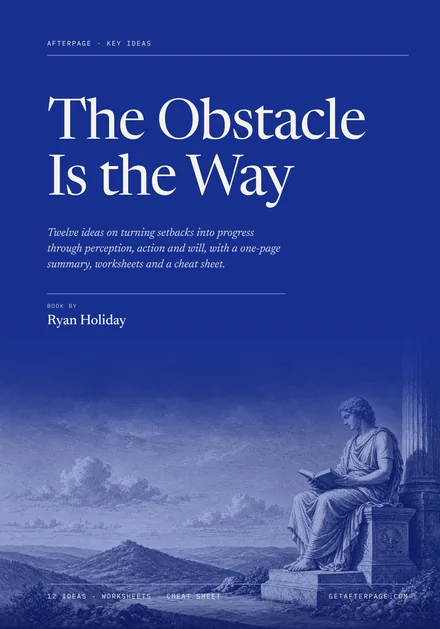
Cover of the Afterpage Key Ideas guide to The Obstacle Is the Way by Ryan Holiday.

Summary · 4-minute read

The Obstacle Is the Way summary

Drawn from our Key Ideas guide to The Obstacle Is the Way by Ryan Holiday. The free PDF goes further, with a one-page summary, worksheets and a cheat sheet.

Everyone faces obstacles: a lost job, a failed project, an illness or simply a problem that will not go away. Ryan Holiday argues that the ancient Stoic philosophers had a practical method for these moments, and that people throughout history have used it, often without knowing its name.

In The Obstacle Is the Way, he turns that method into three disciplines: perception, action and will. This guide condenses the expanded tenth anniversary edition into twelve ideas, with the stories that carry them and practical steps for each. It closes with a one-page summary, two worksheets and a cheat sheet.

1 What stands in the way becomes the way

Ryan Holiday builds the book on one passage from Marcus Aurelius, the Roman emperor who wrote private notes to himself around the year 170, partly while at war. Marcus wrote that our actions may be blocked, but our intentions and attitudes cannot be, because the mind can adapt and turn an obstacle to its own use.

2 See clearly before you act

The first discipline is perception. Holiday's example is John D. Rockefeller, who took his first job as a bookkeeper in Cleveland at sixteen. Two years later came the Panic of 1857, a national financial crisis that hit his city hard. He could have panicked or quit finance for something safer.

3 You keep control of yourself

Holiday tells the story of the boxer Rubin Hurricane Carter. At the height of his career in the mid-1960s, he was wrongly convicted of a triple murder and given three life sentences. When he arrived at prison, he told the warden and guards that he would not give up the one thing he still controlled, himself.

4 Control your emotions and practice objectivity

When America first trained astronauts, Holiday writes, the skill it drilled most was not panicking. NASA rehearsed launch day for them hundreds of times, from breakfast to the ride to the launch site, so nothing would be unfamiliar. John Glenn, the first American to orbit the Earth, kept his heart rate under a hundred beats per minute for nearly a day in space.

5 Change the frame, and ask whether it is up to you

Holiday tells how the Athenian general Pericles was setting sail with 150 ships when an eclipse plunged the fleet into darkness and his crew panicked. Pericles held his cloak in front of a steersman's face and asked whether he was afraid of that darkness. When the man said no, Pericles asked why the cause should matter.

6 Stay in the present and look for opportunity

Holiday lists companies started in depressions or crises, among them FedEx during the 1973 oil crisis, UPS during the Panic of 1907 and Hewlett-Packard during the Great Depression. Their founders could not control the economy. They could only focus on the work in front of them.

7 Get moving, and keep moving

The second discipline is action. Holiday's model is Demosthenes, who was born sickly, lost his father at seven and had his inheritance stolen by his guardians. He also had a severe speech impediment. Yet he set out to become a great speaker after watching one hold a crowd.

8 Persist, and treat failure as practice

For nearly a year in the American Civil War, Ulysses S. Grant tried to take the city of Vicksburg on the Mississippi. He attacked head-on, tried to go around, dug a canal and flooded land to float boats past. Nothing worked, newspapers mocked him and a replacement was waiting.

9 Follow the process, and do each job well

Holiday describes Nick Saban, who coached the University of Alabama football team for seventeen seasons. Saban taught his players to think not about championships but about what they had to do in this drill, on this play, in this moment. He called it The Process.

10 Go around, and use the obstacle against itself

Not every obstacle should be attacked head-on. Holiday notes that George Washington, often pictured as a bold general, mostly avoided big battles with the stronger British army. He hit where he was not expected, kept his small army alive and wore the enemy down.

11 Build your will and prepare for the worst

The third discipline is will, the inner strength for situations you cannot change. Holiday describes Abraham Lincoln's lifelong depression, which twice nearly drove him to suicide. Lincoln learned to endure it, and that endurance, Holiday argues, prepared him to lead through the Civil War.

12 Accept, love what happens and begin again

Some obstacles cannot be overcome, only accepted. Holiday tells how Ernest Hemingway's wife lost a bag containing almost all his manuscripts at a Paris train station in 1922. Years of work vanished. Holiday writes that the loss pushed Hemingway to start fresh and helped him find a new style.

The Obstacle Is the Way in short

The Obstacle Is the Way applies Stoic philosophy to everyday problems. Ryan Holiday starts from a line by Marcus Aurelius: what blocks action can advance it, and what stands in the way becomes the way. Every obstacle, he argues, carries a chance to grow.

Get the free 15-page PDF guide

Key ideas & lessons

The Obstacle Is the Way key ideas: 12 lessons

For people facing a setback, a stuck project or a problem that won't go away, who want a practical way to respond. Less useful if you want deep Stoic philosophy.

Get the free PDF

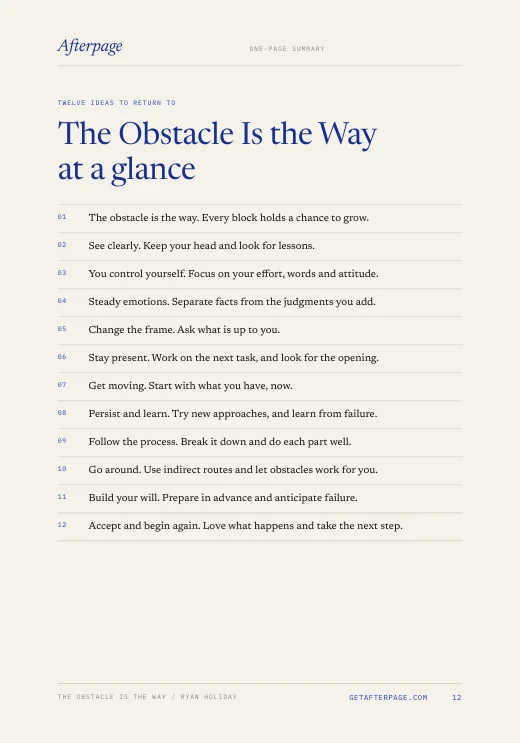
Page 12 of the guide: The Obstacle Is the Way at a glance, the 12 ideas on one page.
Page 12: the one-page summary
  1. The obstacle is the way. Every block holds a chance to grow.
  2. See clearly. Keep your head and look for lessons.
  3. You control yourself. Focus on your effort, words and attitude.
  4. Steady emotions. Separate facts from the judgments you add.
  5. Change the frame. Ask what is up to you.
  6. Stay present. Work on the next task, and look for the opening.
  7. Get moving. Start with what you have, now.
  8. Persist and learn. Try new approaches, and learn from failure.
  9. Follow the process. Break it down and do each part well.
  10. Go around. Use indirect routes and let obstacles work for you.
  11. Build your will. Prepare in advance and anticipate failure.
  12. Accept and begin again. Love what happens and take the next step.

The first lesson to tryPick one obstacle you face now. Write the plain facts, then two columns: what is up to you and what is not. Take one small action from the first column today, and write what the obstacle could teach you.

Day 1

The ideas the week uses

Ryan Holiday builds the book on a line of thinking from Marcus Aurelius: what blocks our action can become the material for it. He turns Stoic philosophy into three disciplines, perception, action and will, and illustrates each with stories from history.

  1. See it clearly. Perception comes first. Holiday urges readers to strip the story and emotion from a problem and see only what is actually happening.
  2. Ask what is up to you. He separates what you control, your judgments and actions, from what you don't, and asks readers to spend their energy only on the first.
  3. Act, and keep acting. Action is the second discipline. Holiday praises steady, persistent effort and treating each failure as practice.
  4. Follow the process. He borrows a football coach's idea: ignore the scoreboard and do the next small task well.
  5. Prepare and accept. Will is the third discipline. Picture what could go wrong, prepare for it, and accept what truly can't be changed, then begin again.

Where it overreachesHoliday tells history in short, selective stories, and some are simplified. The book is a practical guide rather than a study of Stoicism, and it isn't a substitute for help with a serious crisis.

Days 2 to 7

How to apply The Obstacle Is the Way

10 to 20 minutes each, with a two-minute version for a bad day.

Printable week card (one page)

  1. 2Describe the obstacle plainlyWrite down one obstacle you're facing in two or three plain sentences, with no judgment words.
  2. 3Split it into yours and not yoursDivide the obstacle into the parts you control and the parts you don't.
  3. 4Take the next small stepDo one small, concrete action on the item you circled yesterday.
  4. 5Find the opportunityWrite down one way this obstacle could help you, or one thing it lets you do that wasn't possible before.
  5. 6Plan for what could go wrongSpend ten minutes listing what could go wrong with your plan and how you'd respond.
  6. 7Begin againReview the week, accept what didn't change and choose the next step.

Sample

Day 3, in full

This is what lands in your inbox that day.

AfterpageDay 3 of 7 · Action

Split it into yours and not yours

Today’s action · 10 to 20 minutes

Divide the obstacle into the parts you control and the parts you don't.

How

Draw two columns on the page from yesterday. In one, list what is up to you: your effort, your words, your next step. In the other, list what isn't. Circle one item in the first column.

Why this one

Holiday, following the Stoics, argues that energy spent on what we can't control is wasted.

If today is a bad day

Name one part of your problem that is fully up to you.

In short

Questions about this book

What are the key ideas of The Obstacle Is the Way?

The Afterpage Key Ideas guide condenses The Obstacle Is the Way by Ryan Holiday into 12 ideas: The obstacle is the way; See clearly; You control yourself; Steady emotions; Change the frame; Stay present; Get moving; Persist and learn; Follow the process; Go around; Build your will; Accept and begin again.

Is there a free The Obstacle Is the Way summary?

Yes. This page has a 4-minute The Obstacle Is the Way summary drawn from the Afterpage Key Ideas guide. The full guide is a free 15-page PDF with the 12 key ideas, a one-page summary, two worksheets and a cheat sheet, sent by email.

Is The Obstacle Is the Way Key Ideas guide free?

Yes. Enter your email and the 15-page PDF guide arrives in a minute. Next, a 7-day plan by email, starting tomorrow: the big ideas on day 1, then one small action a day. It is free for your first book; membership covers every book.

What is The Obstacle Is the Way about?

The Obstacle Is the Way applies Stoic philosophy to everyday problems. Ryan Holiday starts from a line by Marcus Aurelius: what blocks action can advance it, and what stands in the way becomes the way. Every obstacle, he argues, carries a chance to grow.

What are the main lessons of The Obstacle Is the Way?

The obstacle is the way. See clearly. You control yourself. Steady emotions. Change the frame. Stay present. Get moving. Persist and learn. Follow the process. Go around. Build your will. Accept and begin again. The first one to try: Pick one obstacle you face now. Write the plain facts, then two columns: what is up to you and what is not. Take one small action from the first column today, and write what the obstacle could teach you.

Who is The Obstacle Is the Way by Ryan Holiday for?

For people facing a setback, a stuck project or a problem that won't go away, who want a practical way to respond. Less useful if you want deep Stoic philosophy.

What are the main ideas in The Obstacle Is the Way?

Ryan Holiday builds the book on a line of thinking from Marcus Aurelius: what blocks our action can become the material for it. He turns Stoic philosophy into three disciplines, perception, action and will, and illustrates each with stories from history. See it clearly; Ask what is up to you; Act, and keep acting; Follow the process; Prepare and accept.

What do you do in the Afterpage week for The Obstacle Is the Way?

You get the Key Ideas guide first. The next day, day 1 is a short summary. Then one action a day, each 10 to 20 minutes: Describe the obstacle plainly; Split it into yours and not yours; Take the next small step; Find the opportunity; Plan for what could go wrong; Begin again. Day 7 also has a recap.

Where does The Obstacle Is the Way overreach?

Holiday tells history in short, selective stories, and some are simplified. The book is a practical guide rather than a study of Stoicism, and it isn't a substitute for help with a serious crisis.

What is the first action in The Obstacle Is the Way week?

Describe the obstacle plainly. Write down one obstacle you're facing in two or three plain sentences, with no judgment words. If you only have two minutes: Write one sentence describing your problem with no adjectives.

Membership

Your first book is free. Members get every book.

Pick any book on the shelf, as often as you like, and its Key Ideas guide arrives right away. Next, a 7-day plan by email, starting tomorrow. New books are added regularly.

  • Monthly

    $9.99/month

    Cancel anytime.

  • Yearly

    $79/year

    Save about a third against the standard $9.99 monthly rate.

Want every book? Founding members pay $4.99/month. See membership

Keep reading

Books like The Obstacle Is the Way