Afterpage

Free Key Ideas guide · 15-page PDF

Rich Dad Poor Dad Key IdeasFree PDF guide + 7-day plan

Book by Robert T. Kiyosaki

The book’s 12 main ideas, a one-page summary, two worksheets and a cheat sheet arrive in your inbox now, and a 7-day plan by email starts tomorrow: the big ideas on day 1, then one small action a day.

Your book Rich Dad Poor Dad Robert T. Kiyosaki

Free. 7 days of actions, then up to 3 membership emails. One click to stop. Privacy.

Buy this book at Bookshop.org

We earn a small commission if you buy through Bookshop.org, which supports independent bookstores.

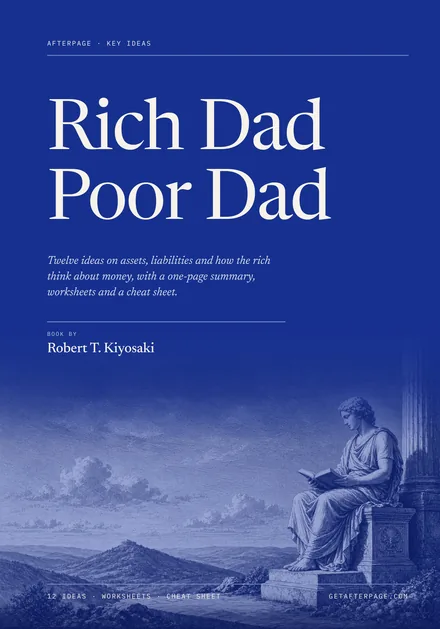
Cover of the Afterpage Key Ideas guide to Rich Dad Poor Dad by Robert T. Kiyosaki.

Summary · 4-minute read

Rich Dad Poor Dad summary

Drawn from our Key Ideas guide to Rich Dad Poor Dad by Robert T. Kiyosaki. The free PDF goes further, with a one-page summary, worksheets and a cheat sheet.

Most people learn about money from their parents, and then rarely question it. Robert Kiyosaki had two sources: his own highly educated father, and the father of his best friend, who left school early and became wealthy. They gave him opposite advice, and he spent his life comparing the results.

In Rich Dad Poor Dad, he turns those lessons into a short list about how the rich think about money, work and assets. This guide condenses the book into twelve ideas, with the stories that carry them and the caveats a fair reader would add. It closes with a one-page summary, two worksheets and a cheat sheet. It is not financial advice.

1 Two fathers, two ways of thinking about money

Robert Kiyosaki frames the book around two father figures. His own father, whom he calls poor dad, was highly educated and worked hard, yet struggled financially all his life. The father of his best friend Mike, whom he calls rich dad, never finished the eighth grade and became one of the wealthiest men in Hawaii.

2 The rich don't work for money

Kiyosaki's first lesson begins when he was 9 years old. He and Mike asked rich dad to teach them how to make money. Rich dad put them to work in one of his convenience stores for 10 cents an hour, three hours every Saturday. Even by 1956 standards, Kiyosaki notes, that was very low pay.

3 See the opportunity others miss

The boys found their first real opportunity at the store. They noticed that the manager tore the covers off unsold comic books, sent the covers back for credit, and threw the rest away. They asked if they could have the discarded comics, and he agreed, as long as they did not resell them.

4 Know the difference between an asset and a liability

Kiyosaki's second lesson is financial literacy. He calls accounting possibly the most boring subject in the world, but also, for anyone who wants to be rich, possibly the most important. So he reduces it to one rule: you must know the difference between an asset and a liability, and buy assets.

5 Your house may not be the asset you think

Kiyosaki's most debated claim follows from his definitions. Poor dad believed his home was his largest investment and greatest asset. Rich dad believed his house was a liability, and said that if your house is your largest investment, you are in trouble.

6 Mind your own business

Kiyosaki's third lesson opens with a story he heard from a friend, Keith Cunningham. In 1974, the founder of McDonald's, Ray Kroc, spoke to an MBA class in Texas and then joined students for beers. He asked them what business he was in. They laughed and said hamburgers.

7 Learn how taxes and corporations work

The fourth lesson is about taxes and what Kiyosaki calls the power of corporations. He says rich dad saw Robin Hood not as a hero but as a crook, and argued that the idea of taxing the rich to help the poor ends up landing hardest on the middle class.

8 Self-doubt holds people back more than lack of skill

The fifth lesson, which Kiyosaki calls the rich invent money, begins with two television stories. One was about Alexander Graham Bell, who offered to sell his telephone patent and company to Western Union for $100,000 and was turned down. The other was about a laid-off manager pleading at the factory gate.

9 Work to learn, not just to earn

The sixth lesson begins in Singapore in 1995. A young newspaper reporter told Kiyosaki she dreamed of being a best-selling author, though her novels were going nowhere. He suggested a sales training course. She was offended and asked whether he meant she should learn to sell.

10 Overcome fear, cynicism, laziness, bad habits and arrogance

In a chapter on obstacles, Kiyosaki names five reasons why financially literate people still fail to build assets: fear, cynicism, laziness, bad habits and arrogance. He takes each in turn and offers a way to work against it.

11 Pay yourself first, and let assets buy luxuries

Kiyosaki closes with ten steps for getting started. One is pay yourself first, which he calls the power of self-discipline. Put money into your asset column before you pay your bills, and let the pressure of the bills push you to find ways to earn more.

12 Financial education starts with the questions you ask

Throughout the book, Kiyosaki returns to education. He argues schools teach people to work for money but rarely teach how money works. Poor dad valued academic credentials. Rich dad valued financial literacy, and Kiyosaki credits that difference for how their lives turned out.

Rich Dad Poor Dad in short

Rich Dad Poor Dad is a book about mindset more than method. Robert Kiyosaki contrasts two father figures to show how habits of thought about money shape a life. One worked for money and valued a safe job. The other had money work for him and valued financial literacy.

Get the free 15-page PDF guide

Key ideas & lessons

Rich Dad Poor Dad key ideas: 12 lessons

For people who earn a paycheck, never learned how money works and want a simple way to tell what builds wealth from what drains it. Less useful if you want specific investment advice.

Get the free PDF

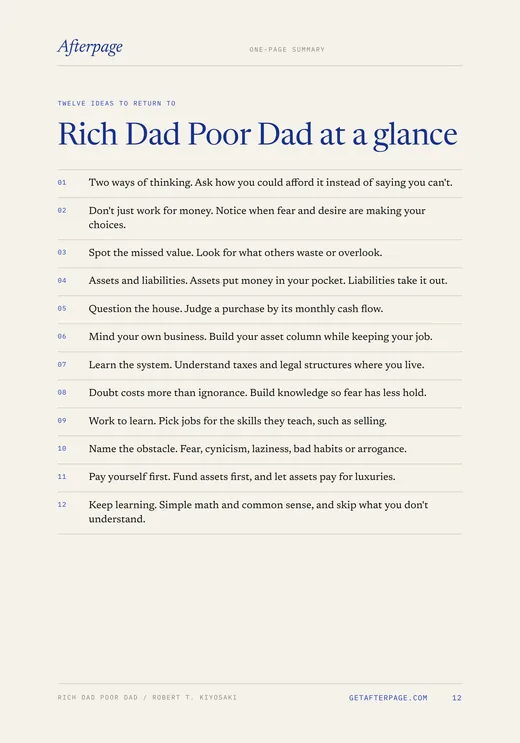
Page 12 of the guide: Rich Dad Poor Dad at a glance, the 12 ideas on one page.
Page 12: the one-page summary
  1. Two ways of thinking. Ask how you could afford it instead of saying you can't.
  2. Don't just work for money. Notice when fear and desire are making your choices.
  3. Spot the missed value. Look for what others waste or overlook.
  4. Assets and liabilities. Assets put money in your pocket. Liabilities take it out.
  5. Question the house. Judge a purchase by its monthly cash flow.
  6. Mind your own business. Build your asset column while keeping your job.
  7. Learn the system. Understand taxes and legal structures where you live.
  8. Doubt costs more than ignorance. Build knowledge so fear has less hold.
  9. Work to learn. Pick jobs for the skills they teach, such as selling.
  10. Name the obstacle. Fear, cynicism, laziness, bad habits or arrogance.
  11. Pay yourself first. Fund assets first, and let assets pay for luxuries.
  12. Keep learning. Simple math and common sense, and skip what you don't understand.

The first lesson to tryList what you own and owe. Mark each item as putting money in your pocket each month or taking it out. Then pick one item to move into the first column this year, and write the first step.

Day 1

The ideas the week uses

Robert Kiyosaki compares two father figures: his own highly educated father, who struggled with money all his life, and his best friend's father, who left school early and became wealthy. His argument is that the difference was not income but financial literacy, and that schools rarely teach it.

  1. Know an asset from a liability. Kiyosaki's simplest rule: an asset puts money in your pocket and a liability takes money out. He says most people struggle because they buy liabilities they think are assets.
  2. Watch your cash flow. He sketches money as flows between income, expenses, assets and liabilities. Wealth grows when income from assets covers your expenses, not when your salary rises and spending rises with it.
  3. Your house may not be an asset. Kiyosaki argues that a home you live in usually takes money out each month, so by his definition it is a liability. This is his most debated claim.
  4. Mind your own business. He separates your profession from your business, meaning your asset column. Keep your day job, he says, but start building assets that keep earning.
  5. Work to learn, not just to earn. Kiyosaki urges readers to choose some work for the skills it teaches, especially selling and communicating, rather than only for the pay.

Where it overreachesKiyosaki's stories are presented as his own, and others have questioned how literally they should be read. His tax and corporation advice is US-specific and dated, and the book gives no detailed investment guidance, so this week sticks to noticing and deciding.

Days 2 to 7

How to apply Rich Dad Poor Dad

10 to 20 minutes each, with a two-minute version for a bad day.

Printable week card (one page)

  1. 2Sort what you own into two columnsList the main things you own or pay for and mark each one as an asset or a liability by Kiyosaki's definition.
  2. 3Draw your cash flowSketch where last month's money came from and where it went, using Kiyosaki's simple flow of income, expenses, assets and liabilities.
  3. 4Pay yourself first, onceMove a small amount into savings or an investment account before you pay any bill this week.
  4. 5List skills worth learningWrite down two skills that would make you more valuable at work or in a side project, and one way to learn each.
  5. 6Ask someone how they built assetsHave a short conversation with someone you know who owns a business, rental or other income-producing asset.
  6. 7Set a monthly asset checkPut a monthly reminder in your calendar to review your two columns and your cash flow.

Sample

Day 3, in full

This is what lands in your inbox that day.

AfterpageDay 3 of 7 · Action

Draw your cash flow

Today’s action · 10 to 20 minutes

Sketch where last month's money came from and where it went, using Kiyosaki's simple flow of income, expenses, assets and liabilities.

How

Draw four boxes: income, expenses, assets, liabilities. Write last month's totals in each, using your statements. Draw arrows for the main flows. Circle the one arrow you'd most like to change.

Why this one

Kiyosaki argues that the pattern of money flowing, not the size of the paycheck, decides whether someone gets ahead.

If today is a bad day

Write last month's income and total spending side by side on a sticky note.

In short

Questions about this book

What are the key ideas of Rich Dad Poor Dad?

The Afterpage Key Ideas guide condenses Rich Dad Poor Dad by Robert T. Kiyosaki into 12 ideas: Two ways of thinking; Don't just work for money; Spot the missed value; Assets and liabilities; Question the house; Mind your own business; Learn the system; Doubt costs more than ignorance; Work to learn; Name the obstacle; Pay yourself first; Keep learning.

Is there a free Rich Dad Poor Dad summary?

Yes. This page has a 4-minute Rich Dad Poor Dad summary drawn from the Afterpage Key Ideas guide. The full guide is a free 15-page PDF with the 12 key ideas, a one-page summary, two worksheets and a cheat sheet, sent by email.

Is the Rich Dad Poor Dad Key Ideas guide free?

Yes. Enter your email and the 15-page PDF guide arrives in a minute. Next, a 7-day plan by email, starting tomorrow: the big ideas on day 1, then one small action a day. It is free for your first book; membership covers every book.

What is Rich Dad Poor Dad about?

Rich Dad Poor Dad is a book about mindset more than method. Robert Kiyosaki contrasts two father figures to show how habits of thought about money shape a life. One worked for money and valued a safe job. The other had money work for him and valued financial literacy.

What are the main lessons of Rich Dad Poor Dad?

Two ways of thinking. Don't just work for money. Spot the missed value. Assets and liabilities. Question the house. Mind your own business. Learn the system. Doubt costs more than ignorance. Work to learn. Name the obstacle. Pay yourself first. Keep learning. The first one to try: List what you own and owe. Mark each item as putting money in your pocket each month or taking it out. Then pick one item to move into the first column this year, and write the first step.

Who is Rich Dad Poor Dad by Robert T. Kiyosaki for?

For people who earn a paycheck, never learned how money works and want a simple way to tell what builds wealth from what drains it. Less useful if you want specific investment advice.

What are the main ideas in Rich Dad Poor Dad?

Robert Kiyosaki compares two father figures: his own highly educated father, who struggled with money all his life, and his best friend's father, who left school early and became wealthy. His argument is that the difference was not income but financial literacy, and that schools rarely teach it. Know an asset from a liability; Watch your cash flow; Your house may not be an asset; Mind your own business; Work to learn, not just to earn.

What do you do in the Afterpage week for Rich Dad Poor Dad?

You get the Key Ideas guide first. The next day, day 1 is a short summary. Then one action a day, each 10 to 20 minutes: Sort what you own into two columns; Draw your cash flow; Pay yourself first, once; List skills worth learning; Ask someone how they built assets; Set a monthly asset check. Day 7 also has a recap.

Where does Rich Dad Poor Dad overreach?

Kiyosaki's stories are presented as his own, and others have questioned how literally they should be read. His tax and corporation advice is US-specific and dated, and the book gives no detailed investment guidance, so this week sticks to noticing and deciding.

What is the first action in the Rich Dad Poor Dad week?

Sort what you own into two columns. List the main things you own or pay for and mark each one as an asset or a liability by Kiyosaki's definition. If you only have two minutes: Write down one thing you own and whether it puts money in or takes money out each month.

Membership

Your first book is free. Members get every book.

Pick any book on the shelf, as often as you like, and its Key Ideas guide arrives right away. Next, a 7-day plan by email, starting tomorrow. New books are added regularly.

  • Monthly

    $9.99/month

    Cancel anytime.

  • Yearly

    $79/year

    Save about a third against the standard $9.99 monthly rate.

Want every book? Founding members pay $4.99/month. See membership

Keep reading

Books like Rich Dad Poor Dad

Best books on money →