Afterpage

Free Key Ideas guide · 15-page PDF

The Millionaire Next Door Key IdeasFree PDF guide + 7-day plan

Book by Thomas J. Stanley and William D. Danko

The book’s 12 main ideas, a one-page summary, two worksheets and a cheat sheet arrive in your inbox now, and a 7-day plan by email starts tomorrow: the big ideas on day 1, then one small action a day.

Your book The Millionaire Next Door Thomas J. Stanley and William D. Danko

Free. 7 days of actions, then up to 3 membership emails. One click to stop. Privacy.

Buy this book at Bookshop.org

We earn a small commission if you buy through Bookshop.org, which supports independent bookstores.

Cover of the Afterpage Key Ideas guide to The Millionaire Next Door by Thomas J. Stanley and William D. Danko.

Summary · 3-minute read

The Millionaire Next Door summary

Drawn from our Key Ideas guide to The Millionaire Next Door by Thomas J. Stanley and William D. Danko. The free PDF goes further, with a one-page summary, worksheets and a cheat sheet.

Ask people to picture a millionaire and most imagine a big house, a luxury car and expensive clothes. Thomas Stanley and William Danko spent two decades surveying and interviewing wealthy Americans, and found that the picture is mostly wrong. Many millionaires live quietly, and many who look rich are not.

The Millionaire Next Door turns that research into seven habits shared by people who build wealth themselves. This guide condenses the book into twelve ideas, with the numbers and case studies behind them and notes on where the data are dated. It ends with a one-page summary, two worksheets and a cheat sheet.

1 The wealthy are not who you think

Thomas Stanley and William Danko spent about twenty years studying who the wealthy in America really are. Their research included interviews with more than five hundred millionaires and surveys of more than eleven thousand high-net-worth or high-income people. What they found surprised them and, they expected, would surprise readers.

2 Seven habits of people who build wealth

From their research, the authors drew seven common factors among people who build wealth. They live well below their means. They spend their time, energy and money in ways that help build wealth. And they care more about financial independence than about showing off their social status.

3 A simple test: what should your net worth be?

The authors give a rule of thumb for expected net worth. Multiply your age by your yearly pretax household income from all sources except inheritance, then divide by ten. Subtract anything you inherited. The result is what someone of your age and income would typically be worth.

4 Big hat, no cattle

The authors borrow a Texan expression for people who look rich but are not: big hat, no cattle. They heard it from a thirty-five-year-old who owned a very successful business rebuilding large diesel engines. He drove a ten-year-old car, wore jeans and lived in a modest house among postal clerks, firemen and mechanics.

5 Frugal, frugal, frugal

The authors call frugality the cornerstone of wealth building. Their survey found that the typical millionaire had never spent more than $399 on a suit, for himself or anyone else. Only about one in ten had ever paid $1,000 or more for one. Many wore inexpensive watches and shopped at ordinary stores.

6 Budgeting and planning are the defense

The authors describe wealth building as offense and defense. Offense is earning a good income. Defense is controlling spending, and they call it the foundation stone of wealth, anchored by budgeting and planning. Many high earners, they found, play strong offense and almost no defense.

7 How you spend time matters as much as money

The authors compare two doctors with similar ages, incomes and families. Dr. South is an under accumulator. His family spends all or more of their income each year, and he worries constantly about money. Dr. North is a prodigious accumulator. He has far fewer worries despite a similar income.

8 You aren't what you drive

Cars are a major theme because they are such a visible status symbol. Many millionaires in the study did not drive new cars. Only about a quarter owned a current-year model, and more than a third had a strong preference for buying only used vehicles.

9 Economic outpatient care can backfire

The authors coin the phrase economic outpatient care for the large gifts and financial help that some wealthy parents give their adult children and grandchildren. It includes help with homes, school fees, cars and regular cash. The parents usually mean well and hope the support will help their children get started.

10 Raise children who can stand on their own

The authors collect guidelines from wealthy parents whose adult children became self-supporting. Never tell children that their parents are wealthy. Whatever your wealth, teach discipline and frugality. And try not to let them realize you are affluent until they have built a disciplined, adult life of their own.

11 Choose the right occupation, and find a niche

Self-employed people made up less than 20 percent of American workers but about two-thirds of the millionaires in the study. Many ran what the authors call dull-normal businesses: welding contractors, auctioneers, rice farmers, pest controllers, mobile-home park owners, and coin and stamp dealers.

12 Wealth is what you accumulate, not what you spend

The book's central message is that wealth comes from discipline more than from income. Many millionaires earn moderate incomes but save consistently, budget carefully and avoid status spending. Many high earners never become wealthy because their spending rises with every raise.

The Millionaire Next Door in short

The Millionaire Next Door challenges the picture most people have of wealth. Thomas Stanley and William Danko found that many millionaires live in ordinary houses, drive used or older cars and run unglamorous businesses. Many people who look rich, on the other hand, have little saved.

Get the free 15-page PDF guide

Key ideas & lessons

The Millionaire Next Door key ideas: 12 lessons

For people with a decent income who wonder why they aren't building wealth, and for anyone tempted to look rich. Less useful if you want investment picks.

Get the free PDF

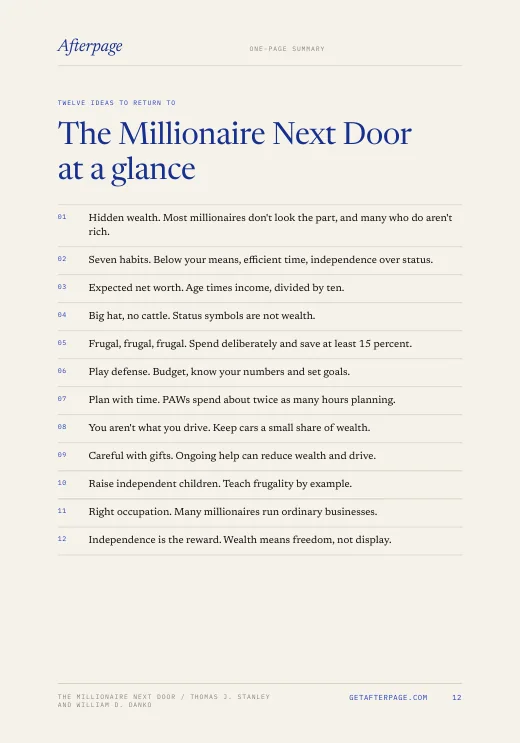
Page 12 of the guide: The Millionaire Next Door at a glance, the 12 ideas on one page.
Page 12: the one-page summary
  1. Hidden wealth. Most millionaires don't look the part, and many who do aren't rich.
  2. Seven habits. Below your means, efficient time, independence over status.
  3. Expected net worth. Age times income, divided by ten.
  4. Big hat, no cattle. Status symbols are not wealth.
  5. Frugal, frugal, frugal. Spend deliberately and save at least 15 percent.
  6. Play defense. Budget, know your numbers and set goals.
  7. Plan with time. PAWs spend about twice as many hours planning.
  8. You aren't what you drive. Keep cars a small share of wealth.
  9. Careful with gifts. Ongoing help can reduce wealth and drive.
  10. Raise independent children. Teach frugality by example.
  11. Right occupation. Many millionaires run ordinary businesses.
  12. Independence is the reward. Wealth means freedom, not display.

The first lesson to tryMultiply your age by your yearly household income and divide by ten. Compare the result with your real net worth. Then track one month of spending on food, clothing and housing, and set one limit to raise your savings.

Day 1

The ideas the week uses

Thomas Stanley and William Danko spent about twenty years surveying and interviewing wealthy Americans. They found that many millionaires live quietly below their means, and many people who look rich are not.

  1. Live well below your means. The most common trait in their research is spending far less than you earn. Many millionaires drove used cars, bought modest suits and lived in ordinary houses.
  2. Test your net worth. Their rule of thumb: multiply your age by your yearly pretax income, divide by ten and subtract inheritances. Compare your real net worth with that figure.
  3. Big hat, no cattle. They borrow a Texan phrase for people who look rich but have little wealth. High spending on status often hides a thin balance sheet.
  4. Budget is the defense. Earning is offense; controlling spending is defense. The authors found many high earners play strong offense and weak defense.
  5. Spend time on building wealth. Prodigious accumulators spend more hours planning their finances than under accumulators with similar incomes, the authors report.

Where it overreachesThe data is from 1990s US surveys and the dollar figures are dated. The book also focuses on accumulation and says little about whether frugality makes people happier, so treat it as a lens rather than a rulebook.

Days 2 to 7

How to apply The Millionaire Next Door

10 to 20 minutes each, with a two-minute version for a bad day.

Printable week card (one page)

  1. 2Run the net worth testWork out your expected net worth with the authors' formula and compare it with your actual net worth.
  2. 3Find your status spendingGo through last month's spending and mark anything you bought mainly so others would see it.
  3. 4Set a spending planWrite a simple monthly spending plan with a limit for each main category.
  4. 5Rethink your next carLook up the full cost of your current car and compare it with a reliable used alternative.
  5. 6Talk about money at homeHave a short conversation with your partner or family about one spending goal.
  6. 7Book a monthly planning hourPut a recurring hour in your calendar to review your spending plan and net worth.

Sample

Day 3, in full

This is what lands in your inbox that day.

AfterpageDay 3 of 7 · Action

Find your status spending

Today’s action · 10 to 20 minutes

Go through last month's spending and mark anything you bought mainly so others would see it.

How

Use your statements. Look at clothes, cars, gadgets, dining and home items. Mark each status purchase with an S and total them. No judgment yet, just the number.

Why this one

The authors argue that spending to look wealthy is one of the main reasons high earners stay poor: big hat, no cattle.

If today is a bad day

Name one recent purchase you made mainly for how it looked to others.

In short

Questions about this book

What are the key ideas of The Millionaire Next Door?

The Afterpage Key Ideas guide condenses The Millionaire Next Door by Thomas J. Stanley and William D. Danko into 12 ideas: Hidden wealth; Seven habits; Expected net worth; Big hat, no cattle; Frugal, frugal, frugal; Play defense; Plan with time; You aren't what you drive; Careful with gifts; Raise independent children; Right occupation; Independence is the reward.

Is there a free The Millionaire Next Door summary?

Yes. This page has a 3-minute The Millionaire Next Door summary drawn from the Afterpage Key Ideas guide. The full guide is a free 15-page PDF with the 12 key ideas, a one-page summary, two worksheets and a cheat sheet, sent by email.

Is The Millionaire Next Door Key Ideas guide free?

Yes. Enter your email and the 15-page PDF guide arrives in a minute. Next, a 7-day plan by email, starting tomorrow: the big ideas on day 1, then one small action a day. It is free for your first book; membership covers every book.

What is The Millionaire Next Door about?

The Millionaire Next Door challenges the picture most people have of wealth. Thomas Stanley and William Danko found that many millionaires live in ordinary houses, drive used or older cars and run unglamorous businesses. Many people who look rich, on the other hand, have little saved.

What are the main lessons of The Millionaire Next Door?

Hidden wealth. Seven habits. Expected net worth. Big hat, no cattle. Frugal, frugal, frugal. Play defense. Plan with time. You aren't what you drive. Careful with gifts. Raise independent children. Right occupation. Independence is the reward. The first one to try: Multiply your age by your yearly household income and divide by ten. Compare the result with your real net worth. Then track one month of spending on food, clothing and housing, and set one limit to raise your savings.

Who is The Millionaire Next Door by Thomas J. Stanley and William D. Danko for?

For people with a decent income who wonder why they aren't building wealth, and for anyone tempted to look rich. Less useful if you want investment picks.

What are the main ideas in The Millionaire Next Door?

Thomas Stanley and William Danko spent about twenty years surveying and interviewing wealthy Americans. They found that many millionaires live quietly below their means, and many people who look rich are not. Live well below your means; Test your net worth; Big hat, no cattle; Budget is the defense; Spend time on building wealth.

What do you do in the Afterpage week for The Millionaire Next Door?

You get the Key Ideas guide first. The next day, day 1 is a short summary. Then one action a day, each 10 to 20 minutes: Run the net worth test; Find your status spending; Set a spending plan; Rethink your next car; Talk about money at home; Book a monthly planning hour. Day 7 also has a recap.

Where does The Millionaire Next Door overreach?

The data is from 1990s US surveys and the dollar figures are dated. The book also focuses on accumulation and says little about whether frugality makes people happier, so treat it as a lens rather than a rulebook.

What is the first action in The Millionaire Next Door week?

Run the net worth test. Work out your expected net worth with the authors' formula and compare it with your actual net worth. If you only have two minutes: Multiply your age by your income and divide by ten. Write the number down.

Membership

Your first book is free. Members get every book.

Pick any book on the shelf, as often as you like, and its Key Ideas guide arrives right away. Next, a 7-day plan by email, starting tomorrow. New books are added regularly.

  • Monthly

    $9.99/month

    Cancel anytime.

  • Yearly

    $79/year

    Save about a third against the standard $9.99 monthly rate.

Want every book? Founding members pay $4.99/month. See membership

Keep reading

Books like The Millionaire Next Door

Best books on money →