Free Key Ideas guide · 15-page PDF
Make Time summary and Key Ideas
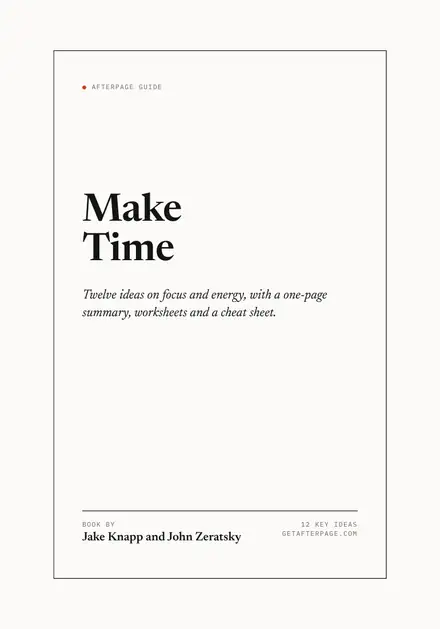
This free plan: choose a daily Highlight and make time for it.
Book by Jake Knapp and John Zeratsky
- Free 15-page PDF12 Key Ideas, a one-page summary, two worksheets and a cheat sheet.
- A 7-day plan by emailStarts tomorrow: one small action a day.
- No card neededNew to the book? Start with the Key Ideas. Read it already? The week puts it to use.
We earn a small commission if you buy through Bookshop.org, which supports independent bookstores.
Summary
Make Time summary: the 12 Key Ideas
Most of us feel busy and distracted, and Jake Knapp and John Zeratsky say that this is not a personal failing. They are product designers who built a daily system, based on their own experiments, called Make Time.
This guide condenses the book into twelve ideas, a one-page summary, two worksheets and a cheat sheet. The tactics come from the authors' experience, and the guide notes where claims are theirs.
1 Busy and distracted is the default, not your fault
Jake Knapp and John Zeratsky say two forces compete for your time. The Busy Bandwagon is a culture of constant busyness: overflowing inboxes, stuffed calendars and endless to-do lists. The Infinity Pools are apps and other sources of endlessly replenishing content. If you can pull to refresh it, or if it streams, it is an Infinity Pool.
2 Four daily steps: Highlight, Laser, Energize, Reflect
The authors describe Make Time as four steps repeated daily. First, choose a single Highlight to prioritize. Second, use tactics to stay laser-focused on it, and they call this state Laser mode. Third, build energy with your body. Fourth, reflect before bed.
3 Pick, test and repeat, without perfection
The authors compare their tactics to a cookbook. You would not try all the recipes at once, and you do not need to do all the tactics at once. They suggest you pick, test and repeat, noting tactics that seem doable but a little challenging, especially those that sound fun.
4 Choose a Highlight you will protect
The first tactic is to write it down. The authors say there is a special power in writing plans, since things you write down are more likely to happen. They suggest making it a daily ritual, in the evening or the morning, and putting it somewhere visible such as a laptop, phone, fridge or desk.
5 Make time for it with the calendar, deadlines and small steps
The authors say that to make time for your Highlight, start with the calendar. Give it a slot, as you would a meeting, so that the time is reserved before other requests fill the day.
6 Try a distraction-free phone
The authors say that removing email and other Infinity Pool apps may be the simplest, most powerful change they have made. Both have had distraction-free phones since 2012. They say it restores quiet and lets them feel less twitchy in moments of boredom.
7 Nix notifications and slow your phone down
The authors call notifications nonstop attention thieves. Whether or not you try a distraction-free phone, they say, you should turn off almost all of them. Leave only critical and useful ones, such as calendar reminders and text messages.
8 Slow your inbox
The authors suggest dealing with email at the end of the day instead of first thing. Checking in the morning gets you sucked into reacting to other people's priorities, they say, and doing it later lets you use your prime hours for your Highlight, though you may have less energy then.
9 Find Laser mode with doors, cues and timers
The authors suggest shutting the door when your Highlight needs focused work. If you have no door, find a room, or put on headphones even without music. A closed door or headphones signals to others that you should not be interrupted, and tells yourself it is time for Laser mode.
10 Exercise a little every day
The authors say that moving your body is the best way to charge your battery, and you do not need long workouts. Their rule is to exercise for about twenty minutes, every day, and to give yourself partial credit. They say the main cognitive, health and mood benefits come in about twenty minutes.
11 Use caffeine strategically
The authors say that in the morning the body makes lots of cortisol, which helps you wake. When it is high, caffeine does little for you, and for most people cortisol peaks between 8 and 9 a.m., so they suggest waiting until after that to have your first cup. Jake says he now feels a bigger boost from his 9:30 coffee.
12 Make your bedroom a bed room, and reflect
The authors argue that looking at social media, email or news before bed sabotages the process of winding down, since an annoying email can keep your brain revving. Their advice is to keep the phone out of the bedroom, and remove TVs, iPads and backlit devices.
Make Time in short
The authors say busyness and distraction are defaults, from the Busy Bandwagon and the Infinity Pools. Make Time has four daily steps: Highlight, Laser, Energize and Reflect. You pick, test and repeat tactics, with no perfection required.
In short
Questions about this book
What is Make Time about?
The authors say busyness and distraction are defaults, from the Busy Bandwagon and the Infinity Pools. Make Time has four daily steps: Highlight, Laser, Energize and Reflect. You pick, test and repeat tactics, with no perfection required.
Who is Make Time by Jake Knapp and John Zeratsky for?
For people whose days disappear into email, feeds, and meetings, who want a light, experimental way to win back an hour or two. Good if big productivity systems haven't stuck for you.
What are the Key Ideas of Make Time?
The Afterpage Key Ideas guide condenses Make Time by Jake Knapp and John Zeratsky into 12 ideas: Defaults; Four steps; Pick, test; Highlight; Make time; Phone; Notifications; Inbox; Laser; Exercise; Caffeine; and Bed room. It also has a one-page summary, two worksheets and a cheat sheet.
Is the Make Time Key Ideas guide free?
Yes. Every guide and 7-day plan is free. Enter your email and the 15-page PDF guide arrives in a minute. Next, a 7-day plan by email, starting tomorrow: one small action a day from the book.
What do you do in the Afterpage week for Make Time?
You get the Key Ideas guide first. Day 1 arrives the next day with one small action from the book. Days 2 to 7 are one action a day, with a two-minute version for a busy day. Day 7 also has a recap.
Do I need to have read Make Time?
No. Start with the Key Ideas guide, then the week: one small action a day. If you have read it, the week puts it to use.
- Building a Second Brain summaryTiago Forte · free Key Ideas guide
- Deep Work summaryCal Newport · free Key Ideas guide
- Digital Minimalism summaryCal Newport · free Key Ideas guide
- Essentialism summaryGreg McKeown · free Key Ideas guide
- Four Thousand Weeks summaryOliver Burkeman · free Key Ideas guide
- Getting Things Done summaryDavid Allen · free Key Ideas guide